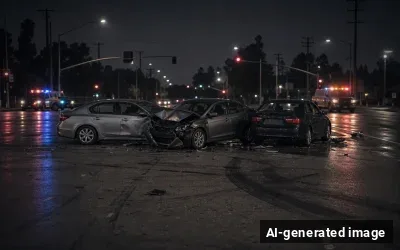

If you have been in a car accident in California, take these steps in order: move to safety and call 911; report the crash; exchange information; photograph the scene; get examined by a doctor even if you feel fine; and notify your insurer. Then track three deadlines that California law imposes on you personally: a written report to police or the CHP within 24 hours if anyone was injured or killed, an SR-1 report to the DMV within 10 days if anyone was injured or property damage exceeds $1,000, and two years from the crash date to file a lawsuit. Missing the two-year deadline ends the claim regardless of how strong it is.
This guide sets out what California law actually requires after a collision, with the statute behind each rule so you can check it yourself. It is general information, not legal advice for your specific situation.
The first seven steps after a car accident
- Get to safety, then call 911. If the vehicles are drivable and blocking traffic, move them to the shoulder. Call 911 for any injury, any impaired driver, or any blocked lane.
- Do not leave. Leaving the scene of an injury crash is a felony in California. Stay until officers release you.
- Exchange information. Name, address, driver’s license number, license plate, insurer, and policy number for every driver. Get names and phone numbers for passengers and independent witnesses. Witnesses disappear within minutes; get the number before they drive off.
- Photograph everything. All four corners of both vehicles, the wider scene showing lane position and signals, skid marks, debris, road conditions, and any visible injury. More is better. You cannot go back later.
- Get medical attention the same day. Adrenaline masks injury, and soft-tissue and head injuries frequently present hours or days later. A gap between the crash and your first medical visit is the single most common argument an insurer uses to discount a claim.
- Report the crash. See the deadlines below. These are your obligations, not your insurer’s.
- Notify your own insurer promptly and stick to the facts. Report the collision; do not speculate about fault or the extent of your injuries before you know.
California’s legal deadlines after a car accident
Four separate clocks start at the moment of impact. They are independent of each other, and three of them are shorter than most people expect.
| Deadline | What is required | When it applies | Authority |
|---|---|---|---|
| 24 hours | Written report of the accident to the CHP, or to the city police department if the crash happened in a city | Any accident resulting in injury to or death of any person | Veh. Code § 20008(a) |
| 10 days | SR-1 report to the DMV, filed by you or through your insurance agent, broker, or lawyer | Property damage over $1,000 to any one person, or any bodily injury, or any death | Veh. Code § 16000(a) |
| 6 months | Written claim presented to the public entity before any lawsuit | Your claim is against a city, county, transit agency, or the state (for example, a dangerous road condition or a government vehicle) | Gov. Code § 911.2(a) |
| 2 years | File the lawsuit in court | Personal injury or wrongful death claims generally | Code Civ. Proc. § 335.1 |
The six-month government-claim deadline is the one that quietly destroys otherwise strong cases. If a pothole, a missing sign, a malfunctioning signal, or a city vehicle contributed to your crash, you generally have six months to present a written claim before you may sue at all. People who wait the “two years everyone knows about” have often already lost that claim.
Call or text (888) 800-6731 or click here for a free case review.
California is an at-fault state, and partial fault does not bar recovery
California is not a no-fault state. The driver who caused the crash, through their liability insurer, is responsible for the resulting harm. That is why fault is contested so heavily after a collision.
California follows pure comparative negligence. Since the California Supreme Court’s decision in Li v. Yellow Cab Co. (1975) 13 Cal.3d 804, being partly at fault reduces your recovery in proportion to your share of the fault, but it does not eliminate it. A driver found 30% at fault on a $100,000 loss recovers $70,000. Even a driver found 90% at fault may still recover 10%. If an adjuster tells you that partial fault means you have no claim, that is not California law.
California raised its minimum insurance limits in 2025
For any policy issued or renewed on or after January 1, 2025, California’s minimum liability limits are $30,000 for injury to or death of one person, $60,000 for injury to or death of two or more people in one accident, and $15,000 for property damage (Veh. Code § 16056(a)(2)). The prior minimums, which had been in place for decades, were 15/30/5.
Two practical consequences. First, a policy written before 2025 and not yet renewed may still carry the old limits. Second, minimum limits remain low relative to what a serious injury costs, which is why your own uninsured and underinsured motorist coverage matters so much. That coverage is yours, you paid for it, and using it is not a claim against a stranger’s policy.
What not to do after a car accident
- Do not say “I’m fine” at the scene. You do not yet know. That sentence appears in adjusters’ notes for years afterward.
- Do not apologize or assign fault. Fault is a legal conclusion drawn from evidence, not a courtesy. Say what happened, not who you think is to blame.
- Do not give a recorded statement to the other driver’s insurer before you understand your injuries. You are not obligated to, and it is requested precisely because it is useful to them.
- Do not accept a quick check before you know your diagnosis. Signing a release ends the claim permanently, including for injuries diagnosed later.
- Do not skip or stretch out treatment. Gaps in care get characterized as evidence that you were not really hurt.
- Do not post about the crash on social media. A photograph of you smiling at a family event will be offered as proof you were not injured.
- Do not assume a minor-damage crash means minor injury. Vehicle damage and human injury correlate far more weakly than insurers suggest.
Frequently asked questions
How long do I have to file a car accident lawsuit in California?
Two years from the date of the crash for personal injury or wrongful death (Code Civ. Proc. § 335.1). If your claim is against a government entity, you must first present a written claim to that entity within six months (Gov. Code § 911.2(a)). Claims involving injured minors follow different rules.
Do I have to report a car accident in California?
Yes, in two separate ways. If anyone was injured or killed, the driver must file a written report with the CHP or city police within 24 hours (Veh. Code § 20008(a)). Separately, you must file an SR-1 with the DMV within 10 days if anyone was injured or killed, or if property damage exceeds $1,000 (Veh. Code § 16000(a)). A police officer responding to the scene does not satisfy your SR-1 obligation.
Is California a no-fault state for car accidents?
No. California is an at-fault (tort) state. The at-fault driver’s liability insurance is responsible for the harm caused. California also applies pure comparative negligence, so your own partial fault reduces your recovery proportionally rather than barring it (Li v. Yellow Cab Co. (1975) 13 Cal.3d 804).
What if the accident was partly my fault?
You can still recover. Your compensation is reduced by your percentage of fault. At 25% at fault on a $80,000 loss, you recover $60,000. There is no cutoff percentage in California that eliminates recovery.
Should I talk to the other driver’s insurance company?
You must report the crash to your own insurer. You are not required to give the other driver’s insurer a recorded statement, and there is rarely a reason to do so early. Their adjuster is trained, is measured on claim cost, and is not neutral. It is reasonable to decline until you have medical clarity or have spoken with a lawyer.
Do I need a lawyer for a minor car accident?
Not always. If nobody was hurt and the property damage is straightforward, you may not need one. Consider talking to a lawyer if anyone was injured, if fault is disputed, if a government entity or commercial vehicle is involved, if the other driver was uninsured, or if an insurer is pressuring you to settle quickly. Most California personal injury lawyers, including this firm, work on contingency and charge no fee unless the case recovers money, so a consultation costs nothing.
What if the other driver has no insurance or fled?
Your own uninsured motorist (UM) coverage may apply, and it also covers hit-and-run crashes in many circumstances. Report a hit-and-run to police promptly, because UM claims typically require it. Check your declarations page for UM and underinsured motorist limits.
Where to go from here
- Car accident claims in California — how fault, insurance, and damages actually work in a car accident case.
- Personal injury representation — the full range of injury matters the firm handles, and the cities we serve.
If you were hurt in a crash anywhere in California, you can talk this through with us at no cost and no obligation. Call or text (888) 800-6731 or click here for a free case review. We practice remotely and can handle your case by phone, text, and video anywhere in the state.
Written and reviewed by Houtan Yaghmai, Esq., President & Managing Attorney of Yaghmai Law Firm, APC, a California personal injury lawyer licensed by the State Bar of California (Bar No. 298487). Last reviewed July 15, 2026.
This article is general information about California law, not legal advice, and does not create an attorney-client relationship. Deadlines and their exceptions depend on facts specific to your situation. If a deadline may be close, speak with a lawyer promptly.